We revisit the momentum-resolved entanglement spectrum (ES) of the spin-1/2 ladder in the Haldane phase, long believed—consistent with the Li-Haldane conjecture—to exhibit a des Cloizeaux-Pearson-type sin|
k| dispersion. Using large-scale exact diagonalization up to 40 spins, we resolve two distinct branches at
k=0 and
k=π, previously conflated by SU(2) degeneracy and finite-size limitations. Breaking SU(2) symmetry via an XXZ deformation drives a quantum phase transition of the entanglement Hamiltonian at Δ
cES≈1, while the bulk remains a gapped symmetry-protected topological phase. In the easy-plane regime (Δ<1), the entanglement ground state becomes quasi-degenerate across
SAz sectors, indicating emergent U(1) symmetry breaking. These findings redefine the prevailing picture of the ES under extensive bipartitioning, establishing a concrete breakdown of the edge-ES correspondence driven by tuning a physical parameter rather than by changing the bipartition. The resulting
entanglement-only criticality reflects effective long-range interactions that circumvent the short-range assumptions underlying the Lieb-Schultz-Mattis (LSM) and Mermin-Wagner/Coleman theorems, opening a new route to study quantum phase transitions that live purely in the entanglement world.
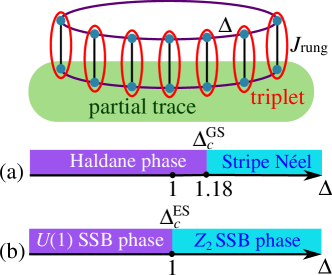 | |
(a) Ground-state phase diagram of the full spin ladder. (b) Entanglement ground-state phase diagram of subsystem by the partial trace of one of the legs. |
Reference:[1] Yu-Chin Tzeng, Gunnar Möller, Dissociation of bulk and entanglement phase transitions in the Haldane phase,
arXiv: 2509.03588Keywords: Li-Haldane conjecture, Exact Diagonalization, spin ladder, Symmetry Protected Topological phase, entanglement spectrum, entanglement Hamiltonian, Continuous Symmetry Breaking, entanglement quantum phase transition, Lieb-Schultz-Mattis (LSM) theorem